Mesothelioma Symptoms: Early Signs and Latency Period
Malignant mesothelioma is a highly aggressive and painful cancer with mesothelioma symptoms and signs that vary from patient to patient and with the area of the body affected.
Mesothelioma most often occurs in the tissue surrounding the lungs (pleural mesothelioma) but can also occur in the tissue in the abdomen (peritoneal mesothelioma), the tissue that surrounds the heart (pericardial mesothelioma) and the tissue surrounding the testicles (mesothelioma of tunica vaginalis).
Because extending the life expectancy of a person with a mesothelioma prognosis depends in large part on early detection, it is vital that patients understand the symptoms of mesothelioma and seek medical attention as soon as they are detected.
Contact your doctor right away if you experience any of the mesothelioma symptoms described below, especially if you had (or have reason to believe that you were) exposure to asbestos fibers, which is the only known cause of asbestos cancers.
If you or a loved one has been diagnosed with mesothelioma, you may be entitled to compensation from asbestos trust funds for medical bills, lost wages, as well as the pain and suffering you have endured.
Contact us today to learn more.
Mesothelioma Symptoms To Watch For: Pain
Over half of all pleural mesothelioma patients have muscle weakness and body aches in the lower, back or sides of the chest.
Sufferers of peritoneal mesothelioma may also experience pain in the abdominal area.
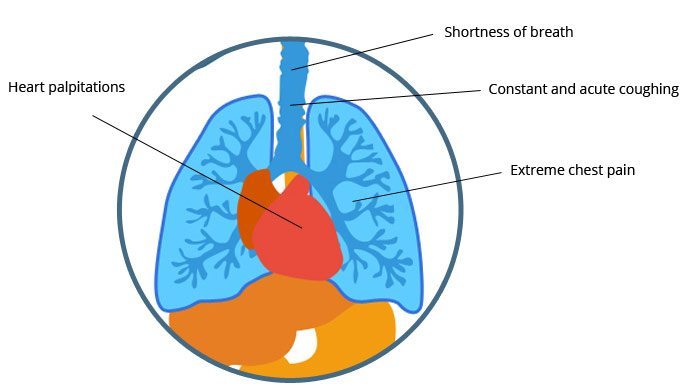
Pericardial mesothelioma patients often have chest pain, heart palpitations, shortness of breath, and constant and acute coughing.
Mesothelioma patient pain areas: typically increases over time and can be acute in many cases, requiring prescription narcotics to manage.
It is important that patients let their physicians know about the pain they are feeling.
Support from a medical team can lessen mesothelioma symptoms by use of these medications:
- Mild pain is typically treated with over-the-counter nonsteroidal anti-inflammatory drugs (NSAIDs) containing ibuprofen, aspirin, naproxen or acetaminophen.
- Moderate pain often involves the use of opioid medications that are sometimes used in combination with NSAIDs. Opioid products are hydrocodone, codeine, methadone or oxycodone.
- Severe pain is often experienced following surgery and is typically managed through “patient-controlled analgesia” whereby the patient can manage the dosage of the painkiller. Most often this is a morphine drip. Higher doses of the moderate pain relievers may be used or other drugs can be prescribed including fentanyl and hydromorphone.
Common Mesothelioma Symptoms by Type
Pleural Mesothelioma (Lungs)
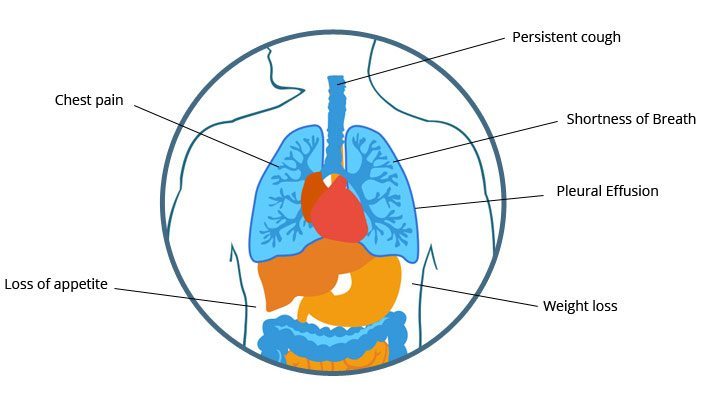
Pleural mesothelioma symptoms and signs are similar to those occurring with less severe respiratory and other diseases, making diagnosis difficult.
Anyone with a history of asbestos exposure should seek immediate medical attention if they experience any of the following mesothelioma symptoms:
- Shortness of breath
- Difficulty breathing
- Chest pain
- Fluid buildup around the lungs (pleural effusion)
- Significant and unexplained weight loss
- Chronic coughing
- Persistent cough
- Dry cough
- Coughing up blood
- Painful coughing
- Loss of appetite
- Difficulty swallowing
- Fatigue
- Respiratory complications
- Lumps under the skin of the chest
Peritoneal Mesothelioma (Abdomen or gastrointestinal)
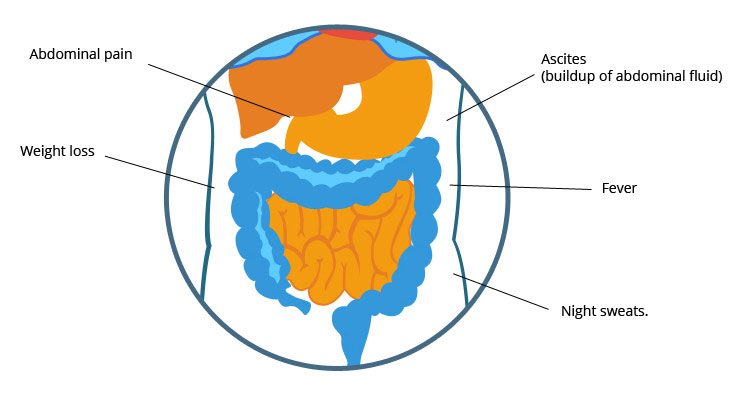
Patients most often experience the following peritoneal mesothelioma symptoms (many of which are often associated with other illnesses):
- Ascites (buildup of abdominal fluid)
- abdominal pain
- unexplained weight loss
- loss of appetite
- nausea and vomiting
- diarrhea or constipation
- bowel obstruction
- anemia
- fever
- night sweats
Pericardial Mesothelioma
Pericardial mesothelioma signs and symptoms are often insidious and may include:
- chest pain
- dyspnea
- heart palpitations
- breathing difficulty
- constant and acute cough
- fluid in the pericardial space
- fever
- night sweating
- paradoxical pulse
- weight loss
- generalized weakness
Tunica Vaginalis Mesothelioma Symptoms
Malignant mesothelioma of the tunica vaginalis represents fewer than 5% of all mesothelioma cases, and so little is known about this type of cancer and its symptoms.
In documented cases, however, a testicular mass, accumulation of fluid in the scrotum and testicular swelling is the common symptom.
Mesothelioma Symptoms Latency Period and Misdiagnose
Malignant mesothelioma symptoms usually emerge in small, subtle ways which appear in other respiratory diseases which can be confusing to the doctor.
Mesothelioma is a rare disease, so it is uncommon for a doctor to examine a patient with mesothelioma. Another difficulty that can cause a misdiagnosis, is that the disease has such a long latency period, between 15 to 60 years after exposure to asbestos, so the patient might not remember being exposed and the doctor will not attribute these symptoms as a cause to the exposure.
How can mesothelioma be diagnosed early?
Its is very important to diagnose the disease in the early stages of mesothelioma for the patient to have better prognosis.
So it is important to look out for these mesothelioma symptoms over the whole body:
- You or someone from your family have been exposed to asbestos? Even if it occurred from 20 to 50 years ago
- A third of all mesothelioma patients diagnosed in the United States are veterans.
- Look out for warning signs, such as pneumonia. A lot of times, people are misdiagnosed with pneumonia and don’t get better.
- When these symptoms present themselves, you need to search for a clinician or a family practitioner that can be more invasive and aggressive to get a better diagnosis. A lot of times, physicians are concerned that doing an invasive procedure is going to add to the patient pain and suffering, which is not really true. Specialists can do a biopsy today in an outpatient setting — same day in and out of the hospital with minimal pain. This would provide a really good tissue diagnosis. When it gets to mesothelioma, early diagnosis is the best treatment.
If your symptoms suggest mesothelioma your doctor will want to follow up with testing, beginning with imaging tests that allow your body to be viewed from the inside and checked for abnormalities such as the presence of fluid or tumors. In addition to helping your doctor make an initial mesothelioma diagnosis, imaging technologies may be used for cancer staging, determining a treatment plan, and tracking response to treatments.
Compensation for Mesothelioma Treatment
If you or a loved one has received a mesothelioma diagnosis, you should know that you may be entitled to compensation from the asbestos companies that causes this cancer and put you in harm’s way.
This compensation could cover your medical bills, any wages you missed from work, as well as payment to account for the pain and suffering that you are being put through.
You and your family should not have to cope with this devastating disease alone.
Contact our patient advocate today to discuss your legal options and learn about the process for pursuing compensation through a mesothelioma lawsuit.
Mesothelioma Symptom Sources & Author:
- Sugarbaker, David J. Garcia, J.P. “Extrapleural Pneumonectomy on the multimodality therapy of malignant pleural mesothelioma. Results in 120 consecutive patients.” Annals of Surgery 1996. September; 224(3): 288-296.
- SEWA S. LEGHA, M.D., F.A.C.P.; and FRANCO M. MUGGIA, M.D., F.A.C.P. “Pleural Mesothelioma: Clinical Features and Therapeutic Implications” Ann Intern Med. 1977;87(5):613-621. doi:10.7326/0003-4819-87-5-613.
- Robinson, B. and Chahinian, A. (2002). Mesothelioma London
- Mayo Clinic. Retrieved from: http://www.mayoclinic.com/health/mesothelioma/DS00779/DSECTION=symptoms. Accessed February 18, 2013.
- American Lung Association. Retrieved from: http://www.lung.org/lung-health-and-diseases/lung-disease-lookup/mesothelioma/mesothelioma-symptoms-causes-risks.html
- Mohit Godar, Jianhua Liu, Pengguo Zhang, Yang Xia, and Qinghai Yuan, “Primary Pericardial Mesothelioma: A Rare Entity,” Case Reports in Oncological Medicine, vol. 2013, Article ID 283601, 4 pages, 2013. doi:10.1155/2013/283601. Retrieved from: https://www.hindawi.com/journals/crionm/2013/283601/
- The Meso Foundation: Symptoms of Pericardial Mesothelioma. The Meso Foundation.
- Suman, S., Schofield, P., & Large, S. (2004). Primary pericardial mesothelioma deaths presenting as pericardial constriction: a case report. Heart, 90(1), e4. Retrieved from: https://www.ncbi.nlm.nih.gov/pmc/articles/PMC1767997/
- Robinson, B. and Lake. R. Advances in Malignant Mesothelioma. (2005). Retrieved from: http://www.accg.org.br/uploads/arquivos/60a8f968b51a724580704995fcfd39c7.pdf
- Moore, A. J., Parker, R. J., & Wiggins, J. (2008). Malignant mesothelioma. Orphanet Journal of Rare Diseases, 3, 34. doi:10.1186/1750-1172-3-34. Retrieved from: https://www.ncbi.nlm.nih.gov/pmc/articles/PMC2652430/?tool=pubmed
- Bridda, A., Padoan, I., Mencarelli, R., & Frego, M. (2007). Peritoneal Mesothelioma: A Review. Medscape General Medicine, 9(2), 32. Retrieved from: https://www.ncbi.nlm.nih.gov/pmc/articles/PMC1994863/
- Plas, E., Riedl, C. R. and Pflüger, H. (1998), Malignant mesothelioma of the tunica vaginalis testis. Cancer, 83: 2437–2446. doi: 10.1002/(SICI)1097-0142(19981215)83:12<2437::AID-CNCR6>3.0.CO;2-G. Retrieved from: http://onlinelibrary.wiley.com/doi/10.1002/SICI1097-01421998121583:122437::AID-CNCR63.0.CO;2-G/full
- Yang LH, Yu JH, Xu HT, Lin XY, Liu Y, Miao Y, Wang L, Fan CF, Jiang GY, Ding SL, et al. Mesothelioma of the tunica vaginalis testis with prominent adenomatoid features: a case report. Int J Clin Exp Pathol. 2014; 7(10):7082-7. Epub 2014 Sep 15. Retrieved from: https://www.ncbi.nlm.nih.gov/pubmed/22208496